When Potty Met Sally
By James Rogoi
Potty was in an abusive relationship before he even knew of his future partner’s existence. Sally on her part was growing out of her then home. The last straw was when she destroyed a vegetable garden next to where she used to live. She next went on to head-butt the same neighbour’s car, starting a feud that would eventually lead to her move. It was decided that she was getting too big and dangerous to continue with the current living arrangements.
Read more
Her future companion was a continent away, suffering terrible abuse at the hands of a cruel circus owner. He was chronically underfed and had little access to water, so much so that his skin was all cracked up, no one was willing to take him in or help him. Somehow, through some kind souls, he found a way to get across the ocean and in 1976, he met up for the first time with the ‘lady’ he’d, hopefully, share the rest of his life with.
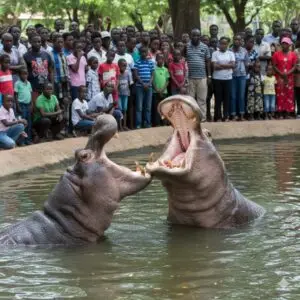
Sally and Potty are today, almost half a century later, still inseparable. In one of the many pools at Haller Park in Bamburi, Mombasa, you will find the hippo power couple together. Sally is 53 and has cataracts in her eyes, her health is slowly failing her and she relies mostly on her 51 year old partner to make her way through their cheeky adventure paths at Haller Park.
Unfortunately, they never had and never will have any calves. They’ve gotten on in age too. Potty’s former master, cruel as he was, made sure that he would never be able to sire any off-springs.
Your partners at Jambotron Safaris will give you a bespoke first-class trip to witness this 50 year hippo romance in the heart of Mombasa in what was once a blast-site for mining. The craters created back then today serve as mini lakes and home to a super diverse ecosystem.
Potty and Sally’s romance and adventures are just but one of the attractions. If you have never seen a literal yellow crocodile, then Haller Park is calling. This is where these magnificent beasts call home. Your standard reptilian section is also open, complete with the constrictors of Africa as well as the deadliest of them all – the black mamba. Don’t worry, she’s behind a glass enclosure where you can watch from a safe distance. There’s also an owl whose partner left him. He keeps an eye out on the park and maybe waits for her to come back.
In the 1860s, Christian missionaries were already on missions in Rabai. A few kilometres from where Haller Park sits, the Omani Sultanate was at its peak. Around the same time, Mzee, the famed and senior-most member of the Haller Park club was being hatched. He waited a long time for it, but at 130, he came to fame following his unusual friendship with a baby hippo named Owen. Their friendship may or may not have caused him the scars he bears today, the staff at Haller may be better placed to tell a more accurate story.
Mzee has a silicone treated permanent crack on his shell. When you do visit, make sure to ask the staff who’s responsible. At Jambotron Safaris, our theory leans towards the naughty twosome of Potty and Sally as those bearing responsibility for Mzee’s injuries. Our facts on this haven’t been checked so please don’t take our word for it.
Injuries and all, today, Mzee is 159 years old! His breed is Aldabra and if you’re lucky, one of the guides will catch a glimpse of him in the foliage foraging.
Every day, at certain times, Haller Park comes to a standstill – it’s feeding time. At 3PM, the giraffes, we counted six when we visited, come from grazing to enjoy the hand-fed pellets visitors are allowed to place on their rough tongues – only after washing your hands of course. We watched a young visitor get in trouble with his mother for licking his hands after feeding the tall giants. We’re always excited about a curious mind.
An hour later at 4PM, it’s the hippos time to be fed. For obvious reasons, only the professionals are allowed to do the feeding. The gasps from the crowd probably lead blind Sally to wonder what all the racket is about. Half an hour later, it’s off to the crocodile pens for big chunks of meat. You won’t want to miss this either.
When in Kenya, and Mombasa in particular, on top of the rich cultural heritage there is to witness, Haller Park is a must see. At Jambotron Safaris, we’re always at hand to talk to you. Together, we will craft out an activity filled holiday for you and your family that will create memories to last a lifetime. Do get in touch with us.
https://tally.so/r/lbBEJp



 Forts of Freedom
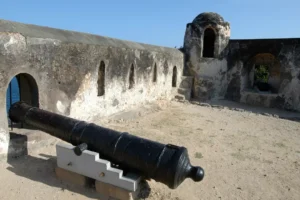 Dom Jeronimo, as the Portuguese call Yusuf will in a few short months abandon the city of his birth for a life on the run in the high seas of the Indian Ocean. The Portuguese will chase but never catch him. They don’t know it then, but that dagger through Gamboa’s heart is the beginning of the end of the Portuguese reign in East Africa.